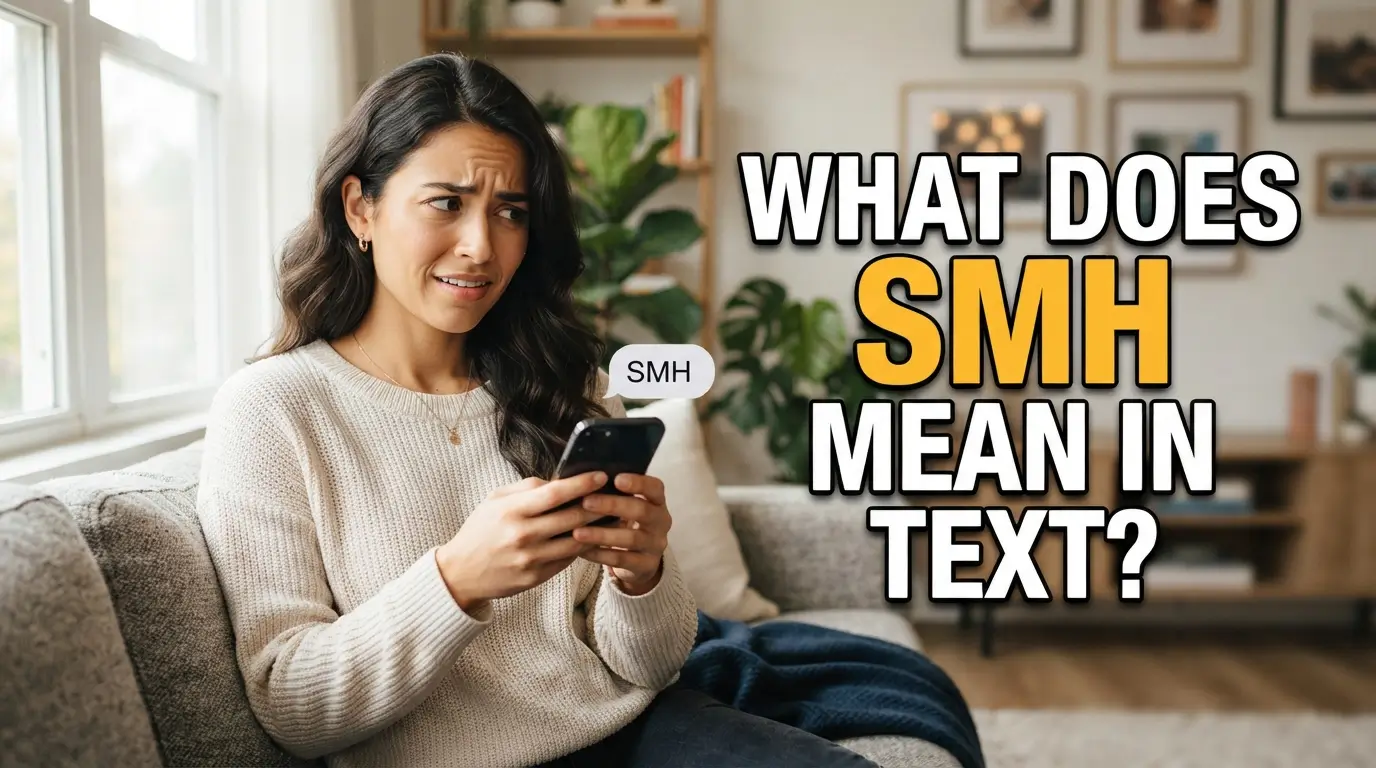
If you have spent any time scrolling through group chats, Instagram comments, or TikTok captions, you have probably run into the letters “SMH” and wondered what they actually mean.
It is one of those internet abbreviations that shows up so often people assume everyone already knows it — until they don’t, and end up typing the phrase into a search bar just to keep up with the conversation.
Short, punchy, and dripping with attitude, this acronym has become a staple of digital communication because it captures a very specific feeling in just three letters.
Understanding it is less about memorizing a definition and more about learning the tone behind it, since the same three letters can express disappointment, humor, disbelief, or gentle teasing depending on who is typing them and why.
This guide breaks down everything you need to know, from its origins to how it shows up across different apps and industries.
Meaning & Definition
At its core, this abbreviation stands for “shaking my head.” It is a text-based stand-in for the physical gesture people make when they are disappointed, unimpressed, exasperated, or amused by something that just doesn’t sit right with them.
Picture someone reading a ridiculous headline, watching a friend make a questionable decision, or seeing a reply that completely misses the point — the instinctive reaction is a slow, side-to-side shake of the head, and that is exactly what these three letters are meant to convey in written form.
What makes this term interesting is that it rarely stands entirely alone. It is usually a reaction to something specific: a comment, a video, a news story, or a person’s behavior. Someone might write “he showed up two hours late, smh” to signal frustration, or “smh, why is this so funny” to express amused disbelief.
The tone can shift dramatically based on punctuation, capitalization, and surrounding words. Written in lowercase and tucked casually at the end of a sentence, it often reads as light and joking. Written in all caps or paired with multiple exclamation points, it can read as genuinely annoyed.
It functions almost like a punctuation mark for emotion — a quick tag that tells the reader “this is how I feel about what I just said or what you just said,” without requiring a full sentence of explanation.
That efficiency is a big part of why it has stuck around in digital slang for so long. In a communication style built around speed and brevity, being able to compress an entire emotional reaction into three letters is genuinely useful.
It is worth noting that context always matters more than the letters themselves. The same abbreviation can signal playful teasing between close friends or sharp criticism directed at a stranger’s behavior online.
Reading the surrounding conversation, the relationship between the people involved, and any accompanying emojis will almost always clarify the intended tone far better than the letters alone.
Background
Like most internet abbreviations, this one didn’t appear overnight with an official announcement — it evolved organically out of the need for faster typing during the early days of text messaging and internet forums.
Back when phone keypads required multiple taps to produce a single letter, and character limits on messaging platforms were far stricter than they are today, abbreviating common phrases became second nature.
Expressions people said constantly in everyday speech got shortened so they could be typed quickly with minimal effort, and “shaking my head” was a natural candidate given how frequently people express disbelief or disapproval in casual conversation.
Early internet culture — chat rooms, instant messaging clients, and online forums from the late 1990s and early 2000s — played a major role in popularizing shorthand like this.
As texting on mobile phones took off in the 2000s, these abbreviations moved from niche forum culture into mainstream daily communication. Millions of people were suddenly typing on tiny keypads, and compressed expressions of emotion became essential shorthand rather than a novelty.
Social media accelerated this shift even further. Platforms with character limits, like early Twitter, rewarded brevity, and abbreviations that could pack a strong emotional punch into a handful of characters thrived.
Over time, this particular one moved beyond typed text and became something people even say out loud, jokingly pronouncing the letters or saying “shaking my head” as a verbal reaction in real conversation — a clear sign of how deeply it embedded itself into everyday language, not just typed messages.
Its longevity is notable in a space where slang often has a short shelf life. Many abbreviations from the same era have faded into obscurity, replaced by newer trends, yet this one has remained consistently relevant across nearly two decades of shifting internet culture, adapting smoothly from flip phones to smartphones to today’s social apps.
Usage in Different Contexts: Chat, Social Media, and Professional Fields
The meaning stays fairly consistent across settings, but the tone and appropriateness shift depending on where it shows up.
In casual text messages and chat apps, it functions as a quick, informal reaction. Friends use it constantly to comment on plans falling through, funny stories, or minor annoyances. It requires no explanation among peers because the context of a personal conversation usually makes the reaction obvious.
On social media, its use expands significantly. It appears in comment sections reacting to viral posts, in captions poking fun at awkward situations, and in replies expressing collective disbelief at something absurd.
Because social platforms are public and viewed by strangers, the abbreviation often communicates a shared reaction — a way of signaling “you and I both know this is ridiculous” to an audience that may not know the poster personally.
In professional or formal settings, this term is generally avoided. Work emails, official reports, and business communications typically call for full, clear language, and slang like this can come across as unprofessional or too casual, especially with colleagues, clients, or superiors who may not be familiar with internet shorthand.
That said, informal workplace chat tools like team messaging apps have loosened this rule somewhat, and coworkers who have a casual rapport sometimes use it in quick internal messages — though even then, it is typically reserved for lighthearted moments rather than serious business matters.
Gaming communities and online forums represent another major context. Players use it constantly during matches to react to bad plays, unexpected losses, or amusing glitches, often alongside other gaming slang.
Forums dedicated to hobbies, news, or entertainment also see frequent use in comment threads, where quick reactions are the norm rather than full paragraphs.
The common thread across all these contexts is informality. Wherever quick, casual, emotionally expressive communication is welcome, this abbreviation fits naturally. Wherever precision and professionalism are required, it tends to disappear.
Meaning in Chat, WhatsApp, Instagram, and TikTok
Across messaging and social apps, the core definition doesn’t change, but each platform gives it a slightly different flavor based on how people communicate there.
In regular text messaging and chat apps, it is used much like a verbal sigh — a quick, low-effort way to react to something a friend just shared. It often appears at the end of a message rather than the beginning, functioning as a final comment on whatever was just discussed.
On WhatsApp, where conversations often happen in family groups, friend groups, and work teams simultaneously, the abbreviation shows up constantly in group chats reacting to shared news, memes, or updates. Because WhatsApp conversations tend to be more personal and ongoing than public social feeds, the tone here is usually affectionate or teasing rather than harsh.
On Instagram, it frequently appears in comments underneath posts, reels, or stories. Someone might comment it under a friend’s embarrassing throwback photo, a celebrity’s questionable outfit choice, or a meme that hits a little too close to home. It also shows up in captions people write about their own posts, often used self-deprecatingly, such as captioning an awkward moment from their own day.
On TikTok, the abbreviation thrives in comment sections reacting to videos, especially ones showing questionable decisions, funny fails, or relatable frustrations. TikTok’s fast-paced, reaction-heavy comment culture makes it a natural fit, often paired with laughing emojis or other slang to amplify the reaction.
Creators themselves sometimes use it in captions to preemptively acknowledge that a video shows something a little embarrassing or silly.
Across all these platforms, emojis frequently accompany the abbreviation to reinforce tone — a laughing emoji softens it into humor, while a straight face or exasperated emoji sharpens it into genuine disapproval.
Meaning in Physics, Medical, and Aircraft Terminology
Outside of texting and social media, the same three letters occasionally appear as an acronym in entirely unrelated technical fields, though these uses are far less common and generally confined to specialist contexts rather than everyday conversation.
In some technical and engineering discussions, similar letter combinations can appear as shorthand for specific measurements or terms unique to a particular company, textbook, or regional convention, but there is no single, universally recognized definition in mainstream physics that corresponds to this abbreviation. Any physics-related use tends to be niche, inconsistent, and specific to the source material rather than a standard term found in general physics education.
In medical contexts, abbreviations are extremely common in charts and clinical shorthand, but this particular combination of letters is not a widely standardized medical term across healthcare systems.
Occasionally, individual institutions or specialties may use similar-looking abbreviations internally for specific procedures or measurements, but this is not something patients or general readers are likely to encounter, and it should never be assumed to carry a fixed medical meaning without confirming the source.
In aviation, terminology is highly standardized through official documentation, and while aviation as an industry uses a huge number of acronyms for equipment, procedures, and instruments, this specific combination is not among the commonly recognized standardized aviation abbreviations used in pilot training or air traffic communication.
The takeaway here is important: outside of internet and text-messaging culture, this abbreviation does not have a single, widely agreed-upon technical meaning.
If it appears in a specialized document, chart, or manual, the safest approach is always to check that specific source’s glossary or key, since technical fields frequently reuse common letter combinations for entirely different, highly specific internal purposes. Readers should never assume a technical meaning carries over from casual texting use, and vice versa.
Common Misconceptions
One frequent misunderstanding is that this abbreviation always signals anger or harsh criticism. In reality, tone varies enormously based on context. Between close friends, it is often lighthearted, even affectionate — a way of teasing someone rather than genuinely criticizing them.
Another misconception is that it is always directed at another person. Very often, people use it to react to their own situation, their own mistake, or their own bad luck. Typing it about oneself is just as common as directing it at someone else.
Some assume it is a relatively new piece of slang tied to a specific app or trend, when in fact it predates most modern social media platforms by well over a decade, rooted in early internet and texting culture rather than any single viral moment.
There is also a misconception that it requires a dramatic reaction to justify its use. In practice, people use it for extremely minor annoyances — a slow elevator, a typo, a mildly inconvenient wait — just as often as for genuinely disappointing news. Its casual, low-stakes flexibility is part of why it remains so widely used.
Finally, some readers assume the meaning shifts depending on which platform it appears on. While tone can vary slightly by context, the core meaning — a written stand-in for shaking one’s head in reaction to something — remains consistent everywhere it is used.
Similar Terms and Alternatives
Several other abbreviations express related but distinct reactions, and knowing the differences helps clarify tone in conversation.
“Lol” and “lmao” both signal amusement, but they lean purely toward humor without the disapproval or disbelief that often accompanies this term. Something can be funny without being disappointing, and vice versa.
“Facepalm,” often written out or represented with an emoji, conveys a very similar sense of secondhand embarrassment or exasperation, sometimes used almost interchangeably in reaction to obviously bad decisions.
“Wow” or “smdh” (sometimes read as an intensified version) push the reaction further into disbelief, occasionally used when something is so surprising that a simple head shake doesn’t feel like enough.
“Bruh” functions as a standalone exclamation of disbelief or mild frustration, often used alongside or instead of the head-shaking abbreviation to react to something absurd.
“Ugh” leans more purely into frustration or annoyance without the disbelief element, useful when something is simply irritating rather than surprising or ridiculous.
Choosing between these alternatives often comes down to intensity and flavor. A head-shaking reaction suggests disappointed disbelief, while laughter-based abbreviations suggest pure amusement, and frustration-based ones suggest irritation without the disbelief component. Many people mix several of these together in a single message to layer complex reactions, such as pairing amusement with disbelief when something is both funny and ridiculous at the same time.
How to Respond to It
Responding appropriately depends heavily on context, since the abbreviation itself doesn’t always specify exactly what triggered the reaction.
If a friend uses it in response to something you said or did, the safest approach is usually to ask what prompted the reaction if it isn’t obvious, or respond with humor if the context makes clear it was lighthearted teasing. A simple laughing response or a playful comeback usually keeps the tone consistent.
If it appears as a reaction to news you shared, whether good or bad, acknowledging the sentiment often works well — agreeing that the situation is indeed frustrating, ridiculous, or disappointing, depending on what was being discussed.
If you see it used publicly, such as in a comment section, responding isn’t always necessary, since it often functions as a passing reaction rather than an invitation for conversation. However, if it is directed at a genuine question or discussion point, offering clarification or your own perspective can help move the conversation forward.
In situations where the reaction feels genuinely critical rather than playful, it can be worth pausing to consider whether the comment reflects a real concern worth addressing, rather than reading past it entirely. Tone can be difficult to judge over text, so when in doubt, a quick clarifying question is often more productive than assuming the worst.
Differences from Similar Words
While several abbreviations overlap in emotional territory, subtle differences separate them meaningfully.
Compared to pure laughter-based reactions, this term carries an added layer of disapproval or disbelief that laughter alone doesn’t capture. Something can make you laugh without disappointing you, and this distinction matters when choosing the right response.
Compared to straightforward frustration terms, this abbreviation tends to carry a slightly more resigned, weary tone rather than sharp anger. It suggests someone shaking their head slowly rather than reacting with intense emotion, which softens its overall impact even when used critically.
Compared to disbelief-focused exclamations, this term is quieter and more understated. It doesn’t demand attention the way an exclamation does; instead, it reads almost like a sigh committed to text, a subtle rather than dramatic reaction.
Understanding these nuances helps in choosing the right abbreviation for a given moment, ensuring the intended tone actually comes across rather than being misread by the recipient.
Relevance in Online Conversations and Dating Apps
In everyday online conversations, this abbreviation remains one of the most efficient ways to express a nuanced emotional reaction without writing a full explanation, which is exactly why it has remained popular across so many different platforms and generations of internet users.
On dating apps specifically, it shows up in a few distinct ways. It might appear in a bio, jokingly referencing something the person finds mildly ridiculous about dating culture in general, such as “smh at people who don’t reply to messages.” It can also appear during conversations, used to react playfully to a match’s joke, a slightly awkward opening line, or a funny story shared during early conversation.
Used well, it can actually function as a light flirtation tool, signaling personality and humor rather than genuine criticism. A well-placed, teasing reaction can make a conversation feel more relaxed and natural, similar to how the phrase functions among established friends. However, overusing it, or using it in response to something a match takes seriously, can come across as dismissive, so reading the tone of the conversation remains important even in a dating context.
Its continued presence across dating apps and casual chat highlights just how deeply this small abbreviation has embedded itself into modern digital communication, remaining relevant well over a decade after it first became common shorthand.
Conclusion
At the end of the day, this small abbreviation carries a surprising amount of emotional nuance for just three letters. Rooted in the simple physical gesture of shaking one’s head, it has grown into a flexible, widely understood piece of digital shorthand used across texting, social media, gaming, and even dating apps.
Its meaning stays fairly consistent everywhere it appears — a written expression of disbelief, disappointment, or amused exasperation — though tone always depends heavily on context, relationship, and accompanying punctuation or emojis.
While it occasionally surfaces in unrelated technical fields as a coincidental acronym, its true home remains casual online conversation, where it continues to thrive as a quick, expressive way to react without needing a full sentence.
Understanding when and how to use it, and how to respond when someone else does, makes navigating modern digital communication just a little bit easier.

Oliver Sterling is a seasoned author and editor with over a decade of experience in English literature and publishing.
He holds a Master’s degree in English Studies from the University of Oxford and is passionate about crafting compelling narratives.